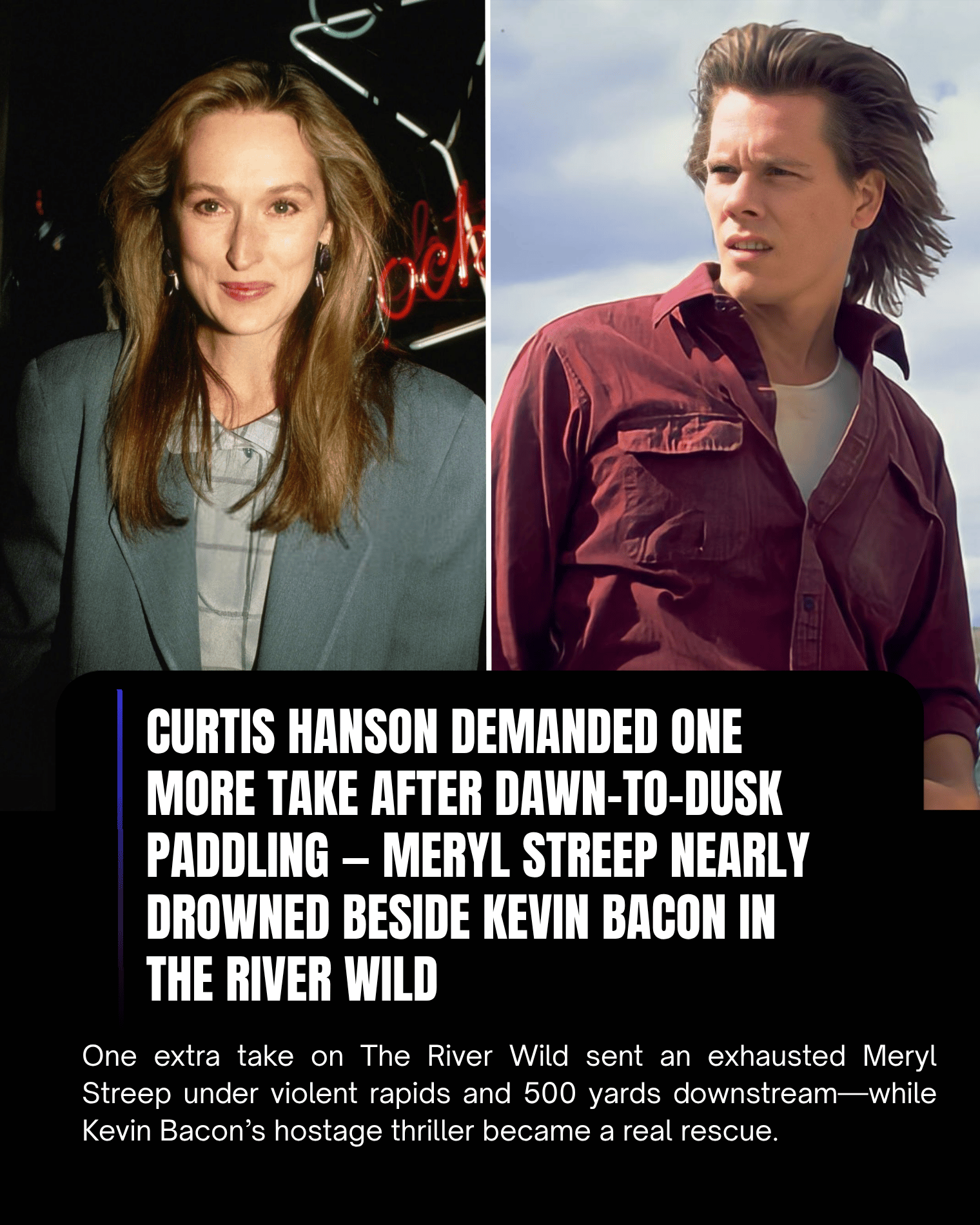
Curtis Hanson Demanded One More Take After Dawn-to-Dusk Paddling — Meryl Streep Nearly Drowned Beside Kevin Bacon in The River Wild became terrifyingly real when a routine filming request ended with its exhausted star disappearing beneath violent rapids.
Meryl Streep had spent the entire day paddling through punishing water while filming the 1994 hostage thriller, pushing her body from dawn toward dusk. By the time director Curtis Hanson requested one final take, she reportedly warned him that exhaustion had already made the stunt unsafe.
Hanson believed the experienced safety crew could manage the danger and asked her to continue, but the river immediately proved otherwise. Streep’s raft overturned, throwing the Oscar-winning actress into freezing, turbulent water before the powerful current pulled her away from the production team.
For several frightening moments, the controlled chaos of a Hollywood action sequence transformed into a genuine emergency unfolding in front of the cast. Streep was dragged underwater and swept roughly 500 yards downstream, unable to simply stand or swim free from the relentless force surrounding her.
A safety kayaker finally reached the actress and helped pull her from the river, ending an ordeal that could have produced an unimaginable tragedy. The woman famous for commanding every emotional detail onscreen had been left physically powerless inside water that ignored rehearsals, cameras and celebrity status.
Kevin Bacon, playing the armed fugitive Wade opposite Streep, was part of a movie built around a family trapped by criminals in dangerous wilderness. Suddenly, the fictional threat surrounding his character seemed almost secondary to the real rescue taking place beyond the carefully planned script.
Streep later confronted Hanson, reportedly joking that she wanted to use her character’s machete on him after surviving the terrifying incident. The humor softened the exchange, but it also carried an unmistakable message about what happens when a performer’s physical limits are dismissed.
Hanson listened, and the director reportedly agreed that he would trust her judgment if she said another stunt had become too dangerous. Their confrontation became a blunt lesson about responsibility, proving that determination cannot replace safety when exhaustion begins weakening even the most prepared performer.
The incident also exposed the demanding preparation behind Streep’s performance, which required her to appear convincing as an experienced whitewater rafter. She trained extensively and performed difficult river work herself, bringing an unusual physical intensity to a role far removed from her celebrated dramatic characters.
That commitment helped make The River Wild a gripping confrontation between Streep’s resourceful mother and Bacon’s increasingly threatening criminal. Yet the most frightening moment connected to the production was never written into the screenplay and required no acting from anyone involved.
Streep survived, returned to work and later used sharp humor when discussing how close the shoot had come to disaster. Her machete remark may have generated laughter, but behind it stood the shock of being swept away after explicitly saying she had reached her limit.
The finished movie turned wilderness danger into entertainment, with Bacon’s menacing performance driving its hostage tension. Behind the cameras, however, Streep’s near-drowning left a more sobering legacy: sometimes the bravest decision on an action set is refusing one more take.